Build a Motivated-Seller List in 10 Minutes
A step-by-step List Stacks walkthrough: area, stacks, distress signals, DTV and equity, motivation score, preview, pull, and straight into skip tracing.
This is the exact sequence for turning "I need sellers in Philadelphia" into a traced, callable list, start to finish, in about ten minutes. It uses Acquired Data's Data Pulling builder (Dashboard → Data Pulling), which runs on our own database of 130M+ properties, and ends with one click into skip tracing. Every record you pull is a flat 1 credit — and free up to your plan's credit amount each cycle if you have a subscription — so the whole exercise costs nothing to set up and only what you actually pull.
Minute 1: Pick the area
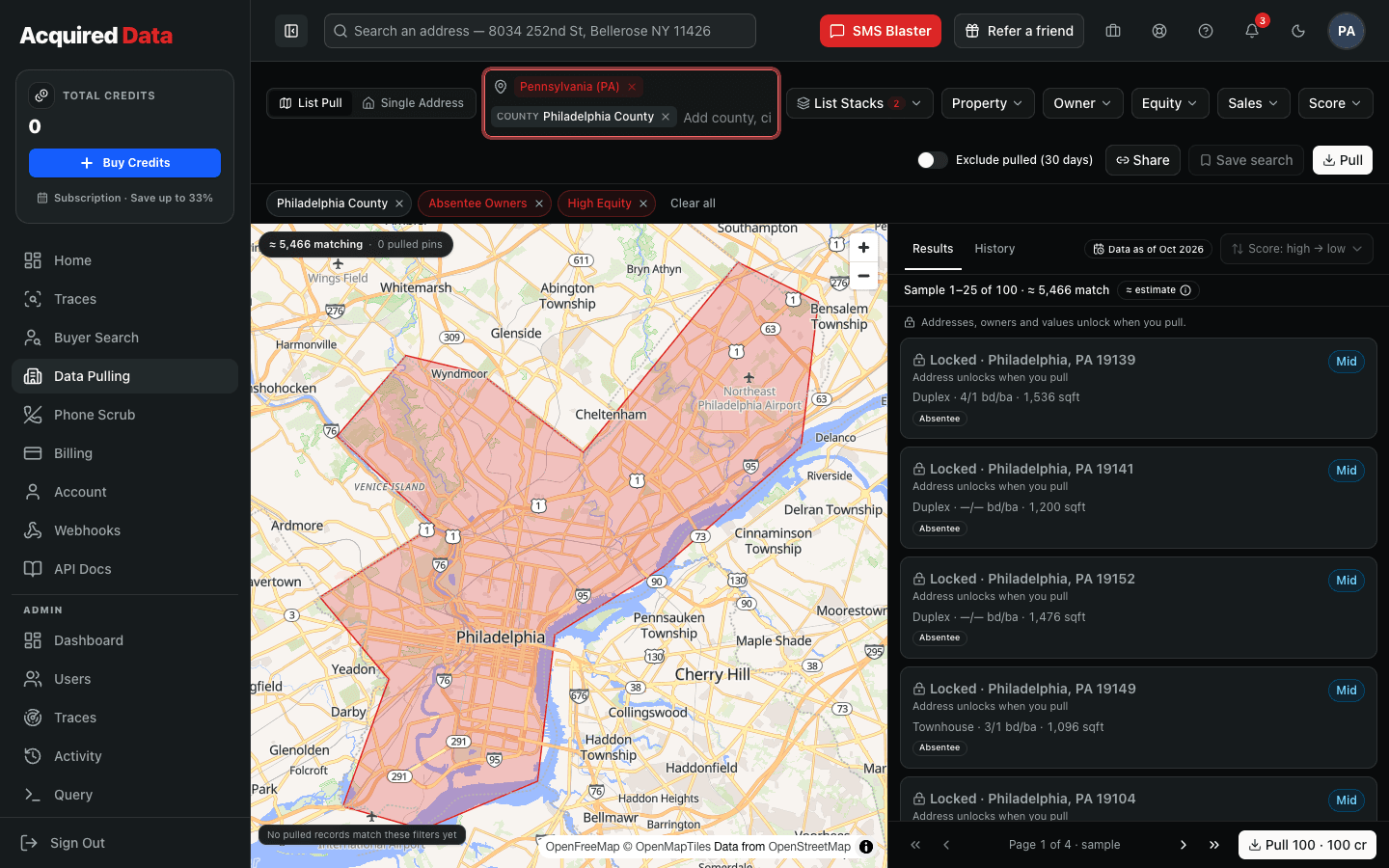
Choose a state, then narrow with counties, cities, or ZIP codes. The map tints what you've selected and the live match count updates with every change. Start broader than you think — a whole county is fine — because the stacks and filters you add next are what shrink the list, and the record cap at the end controls how much you buy. If you work two or three ZIPs, add them all; you can see the count per change and back out of any of them.
Minutes 2–3: Stack the lists
List Stacks are named presets that bundle the filters investors reach for most, grouped into Buyers (Cash Buyers, Recent Buyers, Investors, Likely Flip, Multiple Property Owners) and Sellers(Absentee Owners, High Equity, Free & Clear, Pre-Foreclosure, Vacant, Tired Landlords, Long-Term Owners, Inherited, and more). For a motivated-seller list, start with two:
- Absentee Owners — the owner doesn't live at the property.
- High Equity — enough room in the deal for a discounted offer to still work for them.
Then set the match mode to all. This is the single most important switch in the builder: all means a record must satisfy every stack you picked (a smaller, higher-intent list); any means it can satisfy one of them (a bigger, broader list). Watch the count drop as you switch — that drop is the junk leaving your list. Add a third stack if the count is still large: Long-Term Owners or Out-of-State Owners both tighten the classic absentee list without starving it.
Minute 4: Add distress signals
Distress signals sit alongside the stacks: pre-foreclosure, tax delinquent, involuntary lien, vacant, foreclosure document type, and an auction window of 30 days, 90 days, or a year. You don't need all of them. Pick the one that matches your strategy: tax delinquent for a steady, year-round list; pre-foreclosure with a 90-day auction window if you move fast and can offer a real solution before the sale date; vacant if you're driving the neighbourhood anyway. One signal on top of two stacks is usually the sweet spot — three or four signals matched together produce lists too small to run a campaign on.
Minutes 5–6: Tune equity and DTV
The High Equity stack already screens for equity, but the individual filters let you set the exact band you underwrite to. Two numbers matter most:
- Equity %— how much of the value the owner actually owns. A floor of 40–50% leaves room for a wholesale spread; Free & Clear (100%) owners are the easiest closings and often the least motivated.
- DTV (debt-to-value) — the mirror image, useful for creative-finance lists. If you buy subject-to or on a wrap, flip the logic: look for DTV between roughly 50% and 90% and an open lien with a named lender, because the mortgage is the deal.
Round this out with an estimated-value range that matches what you can actually buy or assign, and a property type filter (single family, 2–4 units) so you aren't paying for condos you'd never pursue. Owner type (Individual vs Corporate) and years owned are the other two that earn their keep on a seller list.
Minute 7: Set a motivation score floor
Every record carries a 0–100 seller Motivation Score, explained per record — the reasons it scored the way it did are shown in the profile, not hidden. Set a minimum and the list sorts itself: a floor of 60 keeps the top band, 40 keeps anyone with a plausible reason to sell. If your count is now in the low thousands for a county-sized area, you've built a tight list. If it's in the hundreds, loosen one thing (drop a distress signal or switch to any) rather than widening the area.
Minute 8: Preview
The results column shows matching records with property type, city and ZIP, size, flags, and score band visible; the address, owner name, and values stay locked until you pull. Scan it. Does the mix look like your buy box? Are the flags the ones you asked for? Very large areas show a 100-record sample, which is plenty to sanity-check the recipe. Turn on Exclude previously pulled if you've pulled in this area in the last 30 days so you only pay for what's new.
Minute 9: Pull
Set the number of records (up to 25,000 per list), name the list something you'll recognise in History — "PHL absentee + equity, tax delinquent, score 60+" beats "List 4" — and click Pull. The summary shows the cost in credits, how many records your free allowance covers, and your balance after, all before anything is charged. You're only charged for records actually delivered; if fewer match, the pull auto-adjusts.
Minute 10: Skip trace it
When the pull completes, choose Skip trace these records. Skip Tracing opens with the list already loaded and the columns mapped, starting on the Add-Ons step. Pick what your channel needs — DNC and phone verification if you're calling or texting, LLC & Trust if the list skews corporate-owned — review the cost, and run it. For a few thousand rows you'll have phones and emails in minutes. The full handoff, including the API version, is covered in From Pull to Skip Trace in One Click.
Three recipes to start from
- Classic wholesale: Absentee Owners + High Equity (all), years owned 10+, single family, score 50+.
- Time-boxed distress: Pre-Foreclosure + Vacant (all), auction within 90 days, any equity. Small, urgent, trace immediately.
- Creative finance: Absentee Owners, DTV 50–90%, open lien present, years owned 3–10, score 40+.
Save the recipe by keeping the pull in History; next week, re-run it with Exclude previously pulled on and you get only the new matches. For why stacking beats volume and more recipes, read Building Targeted Lead Lists; for the full feature tour, the Data Pulling guide.
Keep reading
Building Targeted Lead Lists with Property Data
Why stacking List Stacks and filters beats generic lists, three list recipes to steal, and what a pulled record costs and includes.
Read →BillingWhy Data Pulling Is Free With Every Subscription
How the free property-record allowance works, worked examples for every plan, the pay-as-you-go vs subscription math, and exactly what a record includes.
Read →WorkflowFrom Pull to Skip Trace in One Click
How the pull → Add-Ons handoff works, when to add LLC & Trust resolution, how Exclude previously pulled keeps refreshes cheap, and automating the whole loop with the API.
Read →