Building Targeted Lead Lists with Property Data
Why stacking List Stacks and filters beats generic lists, three list recipes to steal, and what a pulled record costs and includes.
The cheapest way to improve a direct-to-seller campaign isn't a better script or a prettier postcard — it's a better list. A generic "absentee owners in my county" pull might contain thousands of records, most of whom have no reason to sell. Stack two or three motivation signals on top of each other and the list shrinks to the people worth spending marketing dollars on. That's the whole craft: intersection beats volume.
Why stacking works
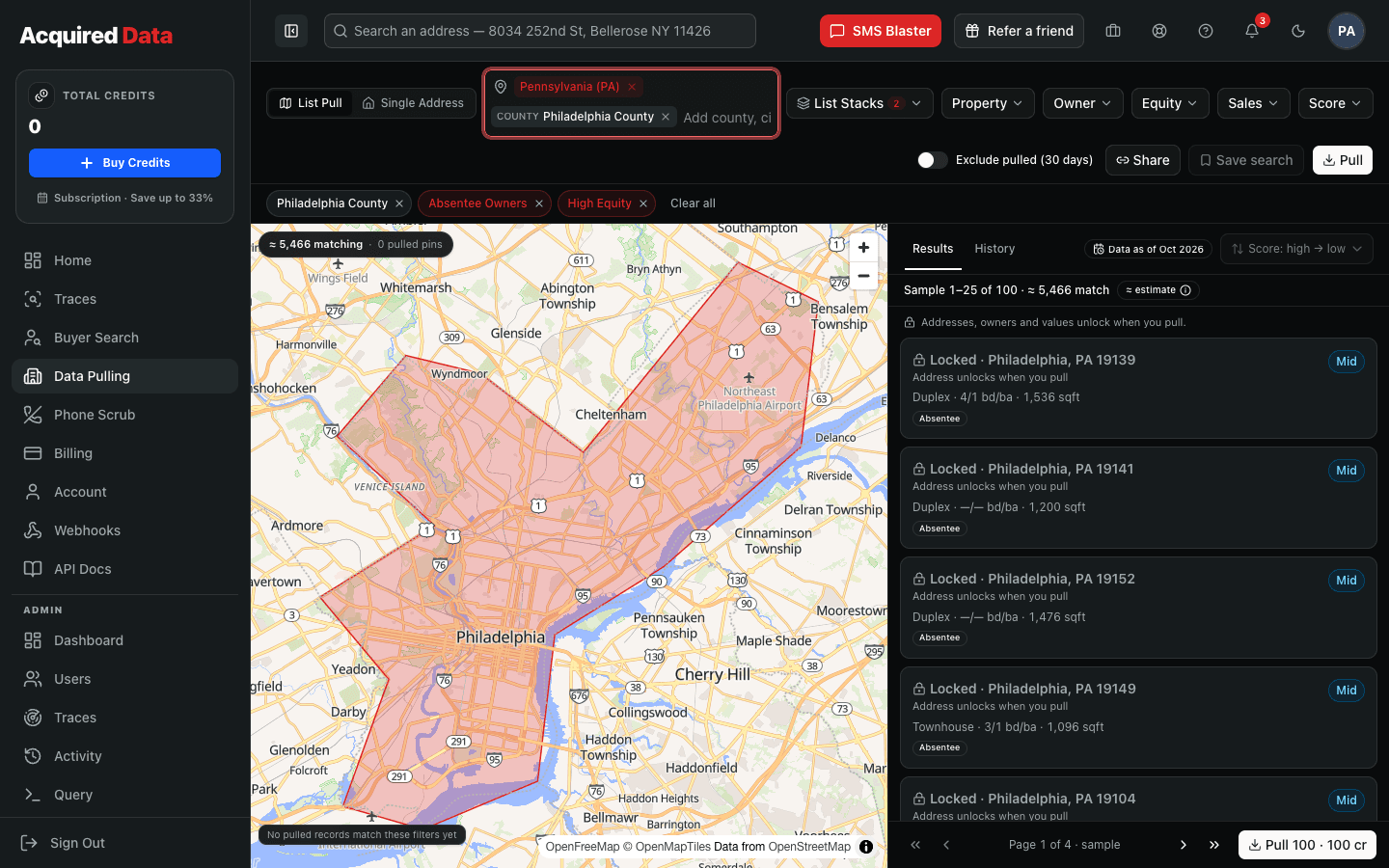
Each signal — absentee, high equity, vacant, pre-foreclosure, out-of-state, tired landlord — is weak on its own. Plenty of absentee owners are happy landlords; plenty of high-equity owners are staying put forever. But signals multiply. An absentee owner with high equity and long ownership has both a reason to sell (done with the property) and the ability to say yes (room to negotiate, no underwater mortgage). Every filter you add cuts list size faster than it cuts deals, which means your cost per real opportunity drops even as the list gets smaller. In Acquired Data's Data Pulling builder those signals are List Stacks — named presets grouped as Buyers and Sellers — and you choose whether a record has to match all of the ones you pick or any of them. The live match count tells you what the stack did to the list before you spend a credit.
Three list recipes to steal
1. The classic: Absentee Owners + High Equity
Stacks: Absentee Owners and High Equity, matched ALL, plus the Long-Term Owners stack or a years-owned filter of 10+, in your target ZIPs. This is the bread-and-butter wholesale list — owners who don't live there, own most or all of the asset, and have had long enough to be done with it. It's competitive because it works; win by adding one more signal (Out-of-State Owners, or a motivation score floor) and by outreach consistency.
2. The distress play: Pre-Foreclosure + Vacant
Stacks: Pre-Foreclosure and Vacant, matched ALL — or the distress signals directly, with an auction window of 30 or 90 days when the clock matters. An owner in default on a property nobody lives in has a hard deadline and no attachment to the asset — the conversation is about solving a problem before the auction does. These lists are small and time-sensitive: pull them fresh, trace immediately, and reach out fast. Lead with help, not hype.
3. The landlord exit: Tired Landlords + Out-of-State Landlord
Stacks: Tired Landlords and Out-of-State Landlord (or Aging Investor Portfolio for the retirement angle), with the portfolio-size filter set to 2+. Managing tenants from three time zones away gets old, and these owners often hold multiple properties — one conversation can turn into a portfolio deal. Expect entity ownership on this list, which is exactly what LLC/Trust tracing is for.
What a pulled record costs — and includes
On Acquired Data, every record from Data Pulling is a flat 1 credit, and subscribers get their plan's monthly credit amount as free records every billing period — a 30,000-credit plan can pull 30,000 records a period before paying a credit. There are no datasets to add, because every record already includes:
- Ownership and contactability: owner name, owner mailing address, owner type, years owned, and portfolio size — the fields that make the row traceable the moment you download it.
- Valuation: estimated value, equity, and DTV (debt-to-value). Pre-compute a max offer for every record before anyone picks up a phone, and prioritize outreach by spread.
- Liens and history: open liens and lender, deed and sale history. This is underwriting data — essential for pre-foreclosure and creative-finance (subject-to, wrap) campaigns where what's owed is the deal.
- Signals: distress flags, quick-list flags, and a 0–100 motivation score with its reasons.
The practical advice changes accordingly: since the data is included, spend your effort on the filters, not on which fields to buy. Tight stacks matched ALL give you a short list of high-intent owners; stacks matched ANY give you reach. Turn on Exclude previously pulled so a weekly refresh only returns what's new since your last pull, and check the match count before you commit.
The pipeline: pull, trace, outreach
- Pull the list with your stacked filters — up to 25,000 records at a time.
- Trace it in bulk (1 credit per row): click Skip trace these records on the finished pull and the wizard opens with the columns already mapped. Add the add-ons your channel requires — DNC/TCPA flags for calling and SMS (line status is included on every trace), LLC/Trust if the list skews entity-owned.
- Outreach with a message that matches the list. The filters already told you why this owner might sell; say that, instead of a generic "we buy houses."
Next steps
Walk through your first pull in the Data Pulling guide, automate it with the property data API (same 1 credit per record), then send the output straight into a bulk skip trace.
Keep reading
Build a Motivated-Seller List in 10 Minutes
A step-by-step List Stacks walkthrough: area, stacks, distress signals, DTV and equity, motivation score, preview, pull, and straight into skip tracing.
Read →BillingWhy Data Pulling Is Free With Every Subscription
How the free property-record allowance works, worked examples for every plan, the pay-as-you-go vs subscription math, and exactly what a record includes.
Read →WorkflowFrom Pull to Skip Trace in One Click
How the pull → Add-Ons handoff works, when to add LLC & Trust resolution, how Exclude previously pulled keeps refreshes cheap, and automating the whole loop with the API.
Read →