Why Data Pulling Is Free With Every Subscription
How the free property-record allowance works, worked examples for every plan, the pay-as-you-go vs subscription math, and exactly what a record includes.
Most property-data tools sell you the list and then sell you the phone numbers — two subscriptions, two meters, and an export cap somewhere in the middle. Acquired Data runs its own nationwide property database, so we did the opposite: Data Pulling is included free with every skip-tracing subscription. Your plan's credits double as a free property-record allowance every 4-week cycle, and only records beyond that allowance cost a flat 1 credit each. This post explains exactly how the allowance works, what it adds up to on each plan, when pay-as-you-go still makes sense, and what you actually get in a record.
How the allowance works
A subscription deposits a fixed number of credits every 4 weeks. Starting the same day, your free property-record allowance equals your plan's credit amount. A 30,000-credit plan gives you 30,000 skip-trace credits and 30,000 free Data Pulling records per cycle — the records don't come out of the credits. Pull 12,000 records in week one and you still have 30,000 credits to trace with and 18,000 free records left to pull.
- Free first, then credits. Records draw down the free allowance first. Once it's used up, each additional record costs 1 credit, taken from plan credits before purchased credits.
- Resets every cycle. The allowance refills at the start of each 4-week cycle. Unused free records don't roll over, so plan pulls against the cycle, not the month.
- Annual plans get the same per-cycle allowance. Annual is one payment covering 13 cycles at a discount; the credits and free records still arrive every 4 weeks.
- Only delivered records count. If fewer records match than you asked for, the pull auto-adjusts — you never spend free records or credits on rows you didn't receive.
The pull summary shows the split before you confirm: records covered by your allowance, records that will cost credits, and your balance afterwards. Nothing is charged until you click Pull.
Worked examples, plan by plan
Here is what each plan includes every 4-week cycle, at the standard prices. The last column is the effective price of a record if you used the whole allowance and nothing else — a way to see what the allowance is worth, not a separate charge.
| Plan credits | Price / 4 weeks | Skip traces | Free property records | If you used only the records |
|---|---|---|---|---|
| 15,000 | $225 | 15,000 | 15,000 | $0.015 / record |
| 30,000 | $360 | 30,000 | 30,000 | $0.012 / record |
| 60,000 | $600 | 60,000 | 60,000 | $0.010 / record |
| 100,000 | $900 | 100,000 | 100,000 | $0.009 / record |
| 200,000 | $1,600 | 200,000 | 200,000 | $0.008 / record |
Read the table as "both columns, every cycle." On the 60,000-credit plan you can pull 60,000 records and trace all 60,000 of them without buying anything else. A direct-mail team pulling 15,000 fresh absentee records a cycle and tracing the 5,000 that make the cut is comfortably inside the smallest plan, with 10,000 credits to spare for single traces, buyer profiles, or add-ons.
Pay-as-you-go vs subscription: the math
Pay-as-you-go credits do not include free records. Without a subscription, Data Pulling is simply 1 credit per record from your purchased credits — same flat rate, same complete record, no export caps, just no allowance. That's still a good deal for occasional pulls, and purchased credits never expire. But if you pull lists regularly, the allowance changes the comparison completely.
Take a team that pulls 20,000 records and traces 20,000 rows a month. On pay-as-you-go that is 40,000 credits of work; a 40,000-credit one-time purchase runs $760 at the entry tier. On the 30,000-credit plan ($360 per 4 weeks) the 20,000 records are free and the 20,000 traces use 20,000 of the 30,000 plan credits — with 10,000 credits left over. The subscription costs about half as much and leaves headroom. Even a team that only pulls — no tracing at all — comes out ahead on a plan once they pull more than roughly 12,000 records a month, because the plan's credits are still there to spend on anything else.
The rule of thumb: if your pulls plus traces exceed the smallest plan's credit amount in a typical month, subscribe — the records alone usually justify it. If you pull a few thousand records a quarter, stay on pay-as-you-go and keep your credits forever. You can also combine the two: a plan for your baseline, one-time credits for the heavy months. The credits post covers the two-bucket model in detail.
Why we can do this
Data Pulling and property profiles run on Acquired Data's own database — 130M+ properties covering every county, refreshed monthly. There is no per-record vendor fee behind each pull, which is what lets us price a record at a flat 1 credit with every dataset included, and give subscribers an allowance that scales with their plan. The free records cost us very little; they cost you nothing; and they make the skip-tracing side of the platform more useful, because the lists you trace are the lists you built.
What a record includes
One record is one property with everything we know about it. There are no datasets to add and no per-field upcharges — each row of a pull contains:
- Property address, owner name, and owner mailing address
- Property details — type, beds, baths, square footage, year built, lot, units
- Estimated value, equity, and DTV (debt-to-value)
- Open liens and lender, plus deed and sale history
- Distress flags and quick-list flags
- A 0–100 seller motivation score with its reasons
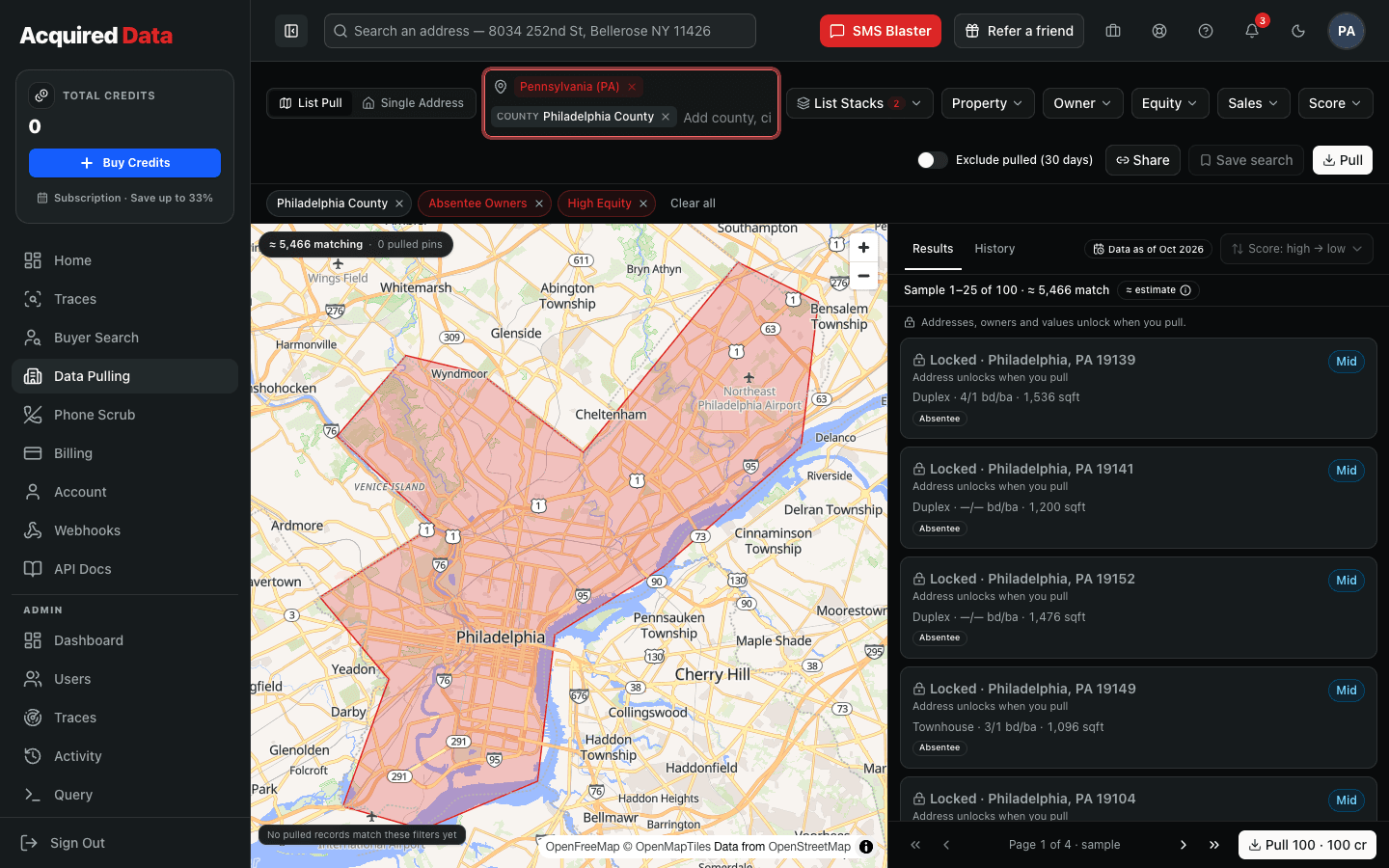
Pulls go up to 25,000 records at a time, Exclude previously pulled keeps a weekly refresh from re-buying records you pulled in the last 30 days, and a finished pull goes into skip tracing in one click. The same pulls — and the same free allowance — are available through the property data API.
Next steps
Walk through a first pull in the Data Pulling guide, or follow the 10-minute motivated-seller list walkthrough. If you're deciding between plans, the credits and billing guide has the full comparison.
Keep reading
Credits, Pricing, and Refunds, Explained
How the credit model works, packs vs. subscriptions, the two credit buckets, and exactly when credits come back automatically.
Read →Lead GenerationBuild a Motivated-Seller List in 10 Minutes
A step-by-step List Stacks walkthrough: area, stacks, distress signals, DTV and equity, motivation score, preview, pull, and straight into skip tracing.
Read →WorkflowFrom Pull to Skip Trace in One Click
How the pull → Add-Ons handoff works, when to add LLC & Trust resolution, how Exclude previously pulled keeps refreshes cheap, and automating the whole loop with the API.
Read →